


In this section both the  and the
  scattering in the environment
are considered to act on both the and the ASDOS.
Again, we start from the single-scattering approximation (12)
to the
scattering in the environment
are considered to act on both the and the ASDOS.
Again, we start from the single-scattering approximation (12)
to the
 and obtain
 |
(16) |
 |
 |
 |
(17) |
 |
|
 |
 :
:
 in
in  ,
,  in
in  ,
,  in
in  and
and  in
in  .
Note that and are composed of just the elements
which produce hybridization effects in the higher-order terms of the
multiple-scattering series.
In detail we obtain
.
Note that and are composed of just the elements
which produce hybridization effects in the higher-order terms of the
multiple-scattering series.
In detail we obtain
 |
|
 |
(18) |
 |
|
 |
|
 |
|
 |
|
 |
|
 |
 indicate that stability
requires highly constructive interference of the electrons at the Fermi level.
Hence, with the stable neighbour-shell sequence, the contributions
to the back-scattering (11) which emerge from all shells must
interfere constructively with each other and destructively with
the electron states of the bare atomic sphere (cf. (10)).
Suppose the
indicate that stability
requires highly constructive interference of the electrons at the Fermi level.
Hence, with the stable neighbour-shell sequence, the contributions
to the back-scattering (11) which emerge from all shells must
interfere constructively with each other and destructively with
the electron states of the bare atomic sphere (cf. (10)).
Suppose the  are the scattering phase shifts of the pseudoatoms
in the stable configuration.
Then the formulas (16,17,18) are really useful.
They show how the electronic interference and the radial structure
of the correlation shell interrelate in order to achieve low ASDOS.
are the scattering phase shifts of the pseudoatoms
in the stable configuration.
Then the formulas (16,17,18) are really useful.
They show how the electronic interference and the radial structure
of the correlation shell interrelate in order to achieve low ASDOS.
The following general conclusions can be drawn:
(i) According to (10,16) low
 is obtained if the shells (the maxima of
  ) coincide with
the minima of
) coincide with
the minima of  .
However, stability requires low total ASDOS,
.
However, stability requires low total ASDOS,
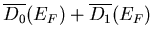 .
The really stable shell sequence will thus result from the competition
between
.
The really stable shell sequence will thus result from the competition
between
 and
and
 .
(ii) Asymptotically, the shells must be uniformly spaced with the
Friedel wave length,
.
(ii) Asymptotically, the shells must be uniformly spaced with the
Friedel wave length,
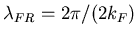 .
This is just the demand of the Nagel-Tauc condition.
The distant shells act "in phase" on the central atomic sphere.
(iii) At smaller distances, the polynomials of powers of
.
This is just the demand of the Nagel-Tauc condition.
The distant shells act "in phase" on the central atomic sphere.
(iii) At smaller distances, the polynomials of powers of
 (18) give rise to deviations from the extrapolated
asymptotic bahaviour.
This is due to the scattering in the environment.
Note that the cosine terms decay only as and act thus
up to considerable distances.
The short-range sensitivity is increased due to the higher powers of
.
On the other hand, contraction and dilation of the close neighbour shells
may also arise from the involved higher electronic angular momenta.
(iv) The condition
(18) give rise to deviations from the extrapolated
asymptotic bahaviour.
This is due to the scattering in the environment.
Note that the cosine terms decay only as and act thus
up to considerable distances.
The short-range sensitivity is increased due to the higher powers of
.
On the other hand, contraction and dilation of the close neighbour shells
may also arise from the involved higher electronic angular momenta.
(iv) The condition
 defines the remarkable situation
where the standards (18) have no long-range parts.
The asymptotic contributions due to and scattering in the environment
cancel out each other.
On such conditions, the system gets short-range confined.
It must be stressed again that the above conclusions are drawn from
single-scattering formulas.
They are derived from the state of the electronic interference which
in turn is a guide line for the multiple scattering.
defines the remarkable situation
where the standards (18) have no long-range parts.
The asymptotic contributions due to and scattering in the environment
cancel out each other.
On such conditions, the system gets short-range confined.
It must be stressed again that the above conclusions are drawn from
single-scattering formulas.
They are derived from the state of the electronic interference which
in turn is a guide line for the multiple scattering.