


Consider the ensemble average of the  ASDOS (10) if only one
scattering event in the environment is included.
With
ASDOS (10) if only one
scattering event in the environment is included.
With 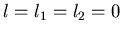 the average reflection amplitude (12)
reduces to
the average reflection amplitude (12)
reduces to
 |
(13) |
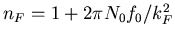 , Fermi index of refraction).
The source emits a unit wave and receives the inward-reflected
amplitude
, Fermi index of refraction).
The source emits a unit wave and receives the inward-reflected
amplitude  .
This term is not important in the present context, because, it does not
depend on
.
This term is not important in the present context, because, it does not
depend on  .
The really interesting term is the second one.
Its real part,
.
The really interesting term is the second one.
Its real part,
 |
(14) |
ASDOS.
However, in contrast to the Fraunhofer diffraction (7) the correlation
shell is now represented by
 instead of the reduced
pair correlation function .
Note also that the present ASDOS-based treatment provides immediately the
sine function as the correct standard to be contrasted with the
shell structure.
The ASDOS will be efficiently reduced at
instead of the reduced
pair correlation function .
Note also that the present ASDOS-based treatment provides immediately the
sine function as the correct standard to be contrasted with the
shell structure.
The ASDOS will be efficiently reduced at  if the neighbour-shell radii
tend to coincide with maxima (sgn
if the neighbour-shell radii
tend to coincide with maxima (sgn ) or with minima
(sgn
) or with minima
(sgn ) of
) of
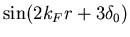 .
Low ASDOS due to scattering in the environment
requires the shell sequence
.
Low ASDOS due to scattering in the environment
requires the shell sequence
 |
(15) |
 will never generate deviations from the uniform shell spacing.