


We deal with the local electronic density of states of atomic spheres
(ASDOS) within the multiple-scattering approach.
A model is adopted where the same representative
muffin-tin (MT) potential is put into each atomic sphere.
 ,
,  ,
,  and
and
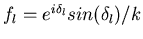 designate the
electron energy, the angular momentum, the MT scattering phase shifts
and the partial scattering amplitudes, respectively.
The partial ASDOS of the embedded atomic sphere number
designate the
electron energy, the angular momentum, the MT scattering phase shifts
and the partial scattering amplitudes, respectively.
The partial ASDOS of the embedded atomic sphere number  ,
,
 |
(10) |
 , and
complex amplitudes,
, and
complex amplitudes,  , which describe the inward back scattering
of MT waves from the environment of the considered atomic sphere.
On passing from MT waves to the multiple scattering of vacuum waves
one obtains [8]
, which describe the inward back scattering
of MT waves from the environment of the considered atomic sphere.
On passing from MT waves to the multiple scattering of vacuum waves
one obtains [8]
 |
(11) |
 performs Fresnel-type diffraction experiments:
Vacuum L-waves are emitted (cf.
performs Fresnel-type diffraction experiments:
Vacuum L-waves are emitted (cf.  ) and propagate towards the environment
(cf.
) and propagate towards the environment
(cf.  ). After multiple scattering which includes the emitting
atomic sphere (cf.
). After multiple scattering which includes the emitting
atomic sphere (cf.  ), the amplitude of the back-scattered vacuum
L-wave is projected out (cf.
), the amplitude of the back-scattered vacuum
L-wave is projected out (cf.  ). The final step transforms
from vacuum waves to MT waves (cf.
). The final step transforms
from vacuum waves to MT waves (cf.
 ).
).
We want to know the radial sequence of neighbour shells which provides
low ASDOS at the Fermi energy.
Suppose an approximation to the ensemble average of the
environment correction (11)
where the pair correlation function  is compared with
certain standards of the radial behaviour similar to the
is compared with
certain standards of the radial behaviour similar to the
 in (7).
In that case the neighbour-shell radii and the radii where the
standards have extreme values have to be correlated in just the same
way as demonstrated in connection with (7) and (8).
This kind of approximation to (11) is obtained upon confining
to single-scattering in the environment ( replaced
by
in (7).
In that case the neighbour-shell radii and the radii where the
standards have extreme values have to be correlated in just the same
way as demonstrated in connection with (7) and (8).
This kind of approximation to (11) is obtained upon confining
to single-scattering in the environment ( replaced
by  ).
The ensemble average can be performed and we arrive at
).
The ensemble average can be performed and we arrive at
 |
(12) |
 are the Legendre polynomials.
The spherical Hankel functions,
are the Legendre polynomials.
The spherical Hankel functions,  , are products of
the asymptotically important factors,
, are products of
the asymptotically important factors,
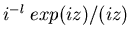 , and
certain l-th order close-range polynomials of 1/z.
, and
certain l-th order close-range polynomials of 1/z.
The following items are to be noted:
(i) Similar to (7) one finds in (12) the pair correlation function
correlated with certain standards of the radial behaviour,
 .
At
.
At  the atomic spheres resolve the close-range behaviour
of the neighbour-shell sequence via Fresnel-type diffraction.
This is beyond the information extracted by in (7).
(ii) Hybridization effects are represented by
scattering-path loops which include at least three scattering events
with two different angular-momentum channels of the considered atomic sphere.
Hybridization is thus disregarded in (12).
Nevertheless, the hybridizing elements of the linking matrix which
are non-diagonal in the angular momentum contribute in (12).
the atomic spheres resolve the close-range behaviour
of the neighbour-shell sequence via Fresnel-type diffraction.
This is beyond the information extracted by in (7).
(ii) Hybridization effects are represented by
scattering-path loops which include at least three scattering events
with two different angular-momentum channels of the considered atomic sphere.
Hybridization is thus disregarded in (12).
Nevertheless, the hybridizing elements of the linking matrix which
are non-diagonal in the angular momentum contribute in (12).
The Nagel-Tauc stability concept demands a minimum
of the ASDOS at the Fermi energy.
According to (10) ASDOS minima arise from strongly negative values
of Re
 .
In the following, employing the single-scattering approximation (12),
the trends are inferred which follows the neighbour-shell sequence
in order to achieve low ASDOS at
.
In the following, employing the single-scattering approximation (12),
the trends are inferred which follows the neighbour-shell sequence
in order to achieve low ASDOS at  .
.