


Neighbour-shell radii can be defined as the distances where
dN(r) = (G(r)+4 r
r  ) rdr has maxima.
We will also employ the reduced pair-correlation function, G(r),
or even the pair-correlation function,
g(r) = 1 + G(r)/(4r), instead of dN(r),
despite of slightly smaller shell radii due to the latter ones.
The neighbour-shell structure describes the residual order
if observations with reference to atoms are averaged.
) rdr has maxima.
We will also employ the reduced pair-correlation function, G(r),
or even the pair-correlation function,
g(r) = 1 + G(r)/(4r), instead of dN(r),
despite of slightly smaller shell radii due to the latter ones.
The neighbour-shell structure describes the residual order
if observations with reference to atoms are averaged.
In common diffraction experiments the diffracted intensity
is proportinal to the structure factor,
 |
(7) |
 , is resolved.
The diffraction peak at
, is resolved.
The diffraction peak at  = 2/
appears particularly pronounced if the shell radii,
= 2/
appears particularly pronounced if the shell radii,  ,
are adapted to the uniformly spaced standard,
,
are adapted to the uniformly spaced standard,  , according to
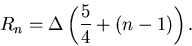 |
(8) |
down to the
first shell and (ii) the first neighbour shell precisely at the distance
(5/4) .
We have demonstrated in section 4 that the empirical  relation (6)
is really the Nagel-Tauc condition,
relation (6)
is really the Nagel-Tauc condition,  , provided that the
 relation (3) is inserted.
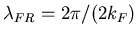
At least the asymptotic neighbour-shell sequence must thus be
uniformly spaced with the Friedel wave length
relation (3) is inserted.
At least the asymptotic neighbour-shell sequence must thus be
uniformly spaced with the Friedel wave length
 .
Experimental results [4] indicate
that the shell radii may even approximate the sequence (8)
at
.
Experimental results [4] indicate
that the shell radii may even approximate the sequence (8)
at
 .
In the latter case we insert (3) into (8) and obtain
.
In the latter case we insert (3) into (8) and obtain
 |
(9) |
 are both accompanied by
highly constructive interference.
are both accompanied by
highly constructive interference.