


The Fermi sphere, the interference cube and
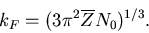
 are connected by the well-known free-electron relation
 |
(1) |
=  /3 = 1.05, this is the situation
where the sphere and the cube touch each other (
/3 = 1.05, this is the situation
where the sphere and the cube touch each other ( =
=  ),
only "umklapp scattering" is amplified by constructive interference.
The next remarkable geometry is reached at
),
only "umklapp scattering" is amplified by constructive interference.
The next remarkable geometry is reached at
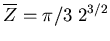 = 2.96 where the Fermi sphere touches just the edges
of the interference cube ( =
= 2.96 where the Fermi sphere touches just the edges
of the interference cube ( =  /
/ ).
Obviously, at
).
Obviously, at
 we will find six caps of the
Fermi sphere outside the interference cube and the rest inside.
We ask if there is an optimal size of the Fermi sphere
which makes most transitions between
points at the Fermi surface accompanied by at least one almost
fulfilled interference condition.
we will find six caps of the
Fermi sphere outside the interference cube and the rest inside.
We ask if there is an optimal size of the Fermi sphere
which makes most transitions between
points at the Fermi surface accompanied by at least one almost
fulfilled interference condition.
In order to answer this question we associate
the six quadratic surface planes of the interference cube
with corresponding parts of the Fermi surface:
As seen from the common center of the two bodies,
each quadratic face fills a solid angle of 4/6=2/3.
We conclude that each quadratic face is "responsible" for just
the part of the Fermi surface which belongs to its solid angle (fig.1b).
Suppose a cap (solid angle  ) of each
  /3 Fermi surface
lies outside the interference cube and
the rest, 2/3 - , lies inside.
The following statement is fundamental for this approach:
Transitions which start at any point of any cap outside the interference cube
and terminate on the opposit side at any point inside the interference cube
have one component of the momentum transfer
approximately equal to the side length of the interference cube.
Hence, they are accompanied by constructive interference.
Just the same holds for the inside-outside transitions.
/3 Fermi surface
lies outside the interference cube and
the rest, 2/3 - , lies inside.
The following statement is fundamental for this approach:
Transitions which start at any point of any cap outside the interference cube
and terminate on the opposit side at any point inside the interference cube
have one component of the momentum transfer
approximately equal to the side length of the interference cube.
Hence, they are accompanied by constructive interference.
Just the same holds for the inside-outside transitions.
Now, the condition for most-constructive interference among scattered waves
can be set up:
The total number of transitions,  ,
is proportional to
,
is proportional to  .
The part
.
The part  of them which is accompanied by almost
constructive interference will be proportional to
of them which is accompanied by almost
constructive interference will be proportional to
 |
(2) |
 is 1/12 and it
occurs at =/3.
Hence, we have to find the radius of a sphere which supplies
a cap of /3 solid angle if cut by a plane at the
distance from the center of the sphere (fig.1c)
The polar angle,
is 1/12 and it
occurs at =/3.
Hence, we have to find the radius of a sphere which supplies
a cap of /3 solid angle if cut by a plane at the
distance from the center of the sphere (fig.1c)
The polar angle,  , fulfils cos()=5/6
which provides a second equation for .
, fulfils cos()=5/6
which provides a second equation for .
 |
(3) |
 |
(4) |
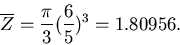
The present treatment proceeds as follows:
(i) A model is postulated which describes the behaviour of the electrons at
the Fermi surface.
(ii) Employing this model, the conditions (3) and (4) are obtained
which ensure that the electrons respond most efficiently to the ions.
Former estimates of the critical electron concentration
have accounted for the perturbing influence of the core electrons.
The results scatter from 1.7 [3] to values between
1.7 and 2.5 [6].
Haeussler [4] estimated values below 2.0 in order to
achieve a space-filling arrangement of Fermi spheres.
Our final relation (3) can be contrasted with empirical results
for certain metallic alloys where the diffraction behaviour
is reasonably approximated by packings of almost equally-sized spheres.
Blétry [7] reported for such alloys
that both the packing fraction,  ,
and the position of the first diffraction peak,
,
and the position of the first diffraction peak,  ,
are well represented by
,
are well represented by
 |
(5) |
 means the diameter of the averages sphere in the alloy.
Upon eliminating the diameter one obtains
means the diameter of the averages sphere in the alloy.
Upon eliminating the diameter one obtains
 |
(6) |
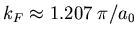 which is very close to our result (3).
We conclude that our - relation (3) meets the situation
of certain metallic glasses which exist obviously close to the
conditions of most-constructive electronic interference.
which is very close to our result (3).
We conclude that our - relation (3) meets the situation
of certain metallic glasses which exist obviously close to the
conditions of most-constructive electronic interference.