


Amorphous and liquid metals provide experimental evidence
[4] that stable ion configurations require strong influence
of the electrons at the Fermi level.
In the present paper strong electronic influence is ascribed to highly
constructive electronic interference which is analyzed
in the single-scattering approximations.
Two aspects of electronic interference are seen in this paper.
First, a condition is searched which ensures that all scattered waves
add up to a strong field without restricting the phase of this
resulting scattered field.
We obtain the relation
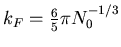 between the
Fermi wave number and the atom number density which provides the
critical number
between the
Fermi wave number and the atom number density which provides the
critical number
 of nearly free electrons per atom
in agreement with experiments [4] [7].
of nearly free electrons per atom
in agreement with experiments [4] [7].
A second aspect, namely the importance of the phase difference between
the scattered field and the primary field,
becomes obvious if the consequences are investigated
which arise from constructive electronic interference.
In this respect and in view of the Nagel-Tauc concept we deal with
the environment contribution to the local electronic density of states
of an atomic sphere.
This contribution is due to the interference of a wave which emerges from
this atomic sphere with a wave which is scattered back from its environment.
We ask which sequence of the
reflecting neighbour shells provides the reflected wave at  in opposite phase to the emerging wave.
This must generate a minimum of the total density of electron states at
and thus stability of the system.
in opposite phase to the emerging wave.
This must generate a minimum of the total density of electron states at
and thus stability of the system.
We show that different partial components of the electronic density of states
impose not necessarily the same trend on the shell sequence.
The case of hcp zinc reveals clearly the competition of two different trends.
We show that only the asymptotic shell sequence is necessarily
uniformly spaced with the Friedel wave length.
The shells close to the central atom, however,
may deviate from the extrapolated asymptotic sequence due to the
higher electronic angular momenta involved.
We emphasize that the radial distribution of atoms in metallic materials
reveals the importance of scattering paths cycles which involve only one
scattering event.
Generally, scattering-path statistics may be a key to the extraction
of physically important trends in topologically disordered systems.
Acknowledgements
This work has been supported by the Deutsche Forschungsgemeinschaft (DFG-contract number So 288/1-1).