Disentangling representations of grouped observations in adversatial autoencoders

Felix Pfeiffer

14.11.2018

Motivation

A (good) representation is easy to exploit.

Facial Action Classification

  • hard to get sufficient amount of labeled data
  • finding representations unsupervised
  • profit ?

First Impression

from Kamil Czarnogórski

int8.io/variational-autoencoder-in-tensorflow

Autoencoder

trained on one face

“Picture of a face”

↓

Autoencoder

↓

Representation

=

“nearly” FA Code

trained on multiple faces

“Picture of a X face”

↓

Autoencoder

↓

Representation

=

“XnXeaXrXlXy” FXA CXoXdXe

The solution

Autoencoders

Probabilistic Models

  • model (e.g. ANN) that acts like a certain p.d.f.
  • naive model wont work

Generative Adversarial Network

Variational Autoencoder

Adversarial Autoencoder

AAE training

Disentangling Algorithm

Grouped observations

Batch evaluation

Batch evaluation disentangled

Hijacking the style

Experiments

Setup

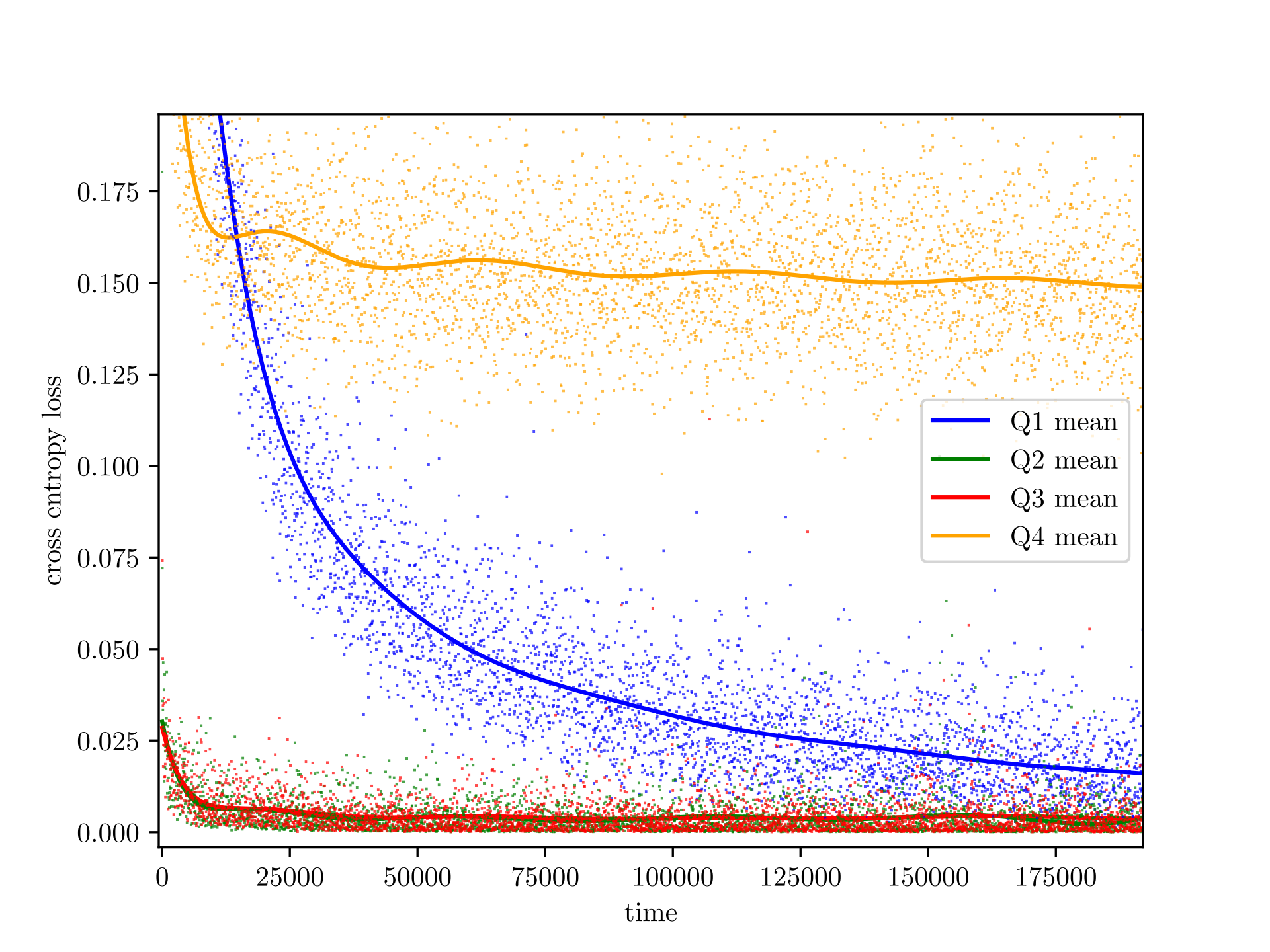
  • Quantitative: classifying CMNIST (4 setups)
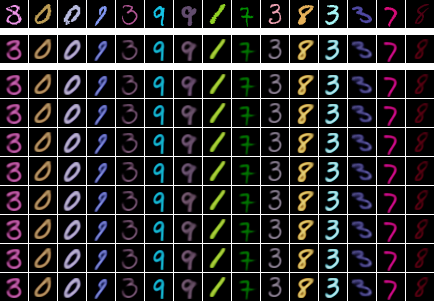
  • Qualitative: manipulating representations, then reconstructing

Q1: full classifier

Q2: classifier on full entangled representation

Q3/Q4: classifier on each representation

Results

Training error

Recognition rate

Reconstruction

Latent cross product

Random style

Random content

Conclusions, outlook, discussion

Conclusions

  • It lives !
  • stripping the style improves classification performance
  • style holds (nearly) no information on content
  • no dependency on each other when reconstruction with recombination
  • non proportional error, when randomizing style

Outlook, discussion

  • More complex dataset: e.g. YTFDB
  • better classifier: may outperform Q1 ?
  • reconstruction imbalance: learning defect or feature complexity difference ?
  • any difference with an explicit variance regularizer on style ?
  • comparing to VAE that works on parameters
  • β-VAE + this.algorithm: get they along ?

A failed try on YTFDB

Notable Literature

D. Bouchacourt, R. Tomioka, and S. Nowozin: ‘Multi-level variational autoencoder: Learning disentangled representations from grouped observations’, 2017

Thank you for your attention !